Wednesday, 21 March 2012

A modest proposal

I've borrowed this post's title from Jonathan Swift's essay, in which he satirically suggests that the Irish cope with food shortages by eating their babies. Like Swift, I shall be addressing the topic of society's youngest members. While I hope my thoughts will not be devoid of humor, I am however quite seriously calling for a public debate on the behavior of middle class progeny in public spaces.

Full disclosure: I do not have children. I do not want children. That said, this is not part of some rampant child-hating campaign; I have a few friends with children and I expect that number to increase with time. If having kids makes them happy and fulfilled - and it obviously does - then I'm pleased for them. The bone I wish to pick here is not about kids or parenting per se, but rather the way in which public spaces are used and shared by people with and without children. Since moving back to the UK last autumn, I've become increasingly aware of the encroachment of children, socially and spatially, on neutral and adult territory. The problem is significantly more pronounced in my new, allegedly-swanky North London hood than in my previous stomping ground of Shepherds Bush. This is not a parents v. childless adults debate - I know most people don't allow their children to behave like this and I've seen many a parent (including my own mother) outraged at the offences detailed below. Still, there are bad (or just clueless) apples in every bunch and we could clearly benefit from some guidelines to help us coexist peacefully. Accordingly, I (modestly) propose the following:

1. When in Rome: Observe the ambience of the space you're in and emulate. This works both ways: just as one shouldn't settle in with a six-pack of cider and a pack of fags at the local playground, so too should unruly toddlers steer clear of wine bars. Different venues offer different experiences. No single patron has the right to continuously disrupt the specific ambience of particular place and proprietors should be unafraid to defend their customers' rights to the experience they have chosen and are paying for.

2. No scooters on city sidewalks (or in shops): Last weekend I watched a father of twin toddlers, both with scooters. In less than 2 minutes, one of the girls fell over and smacked her head on the pavement whilst the other lost control of her scooter which rolled into the path of a (mercifully slow-moving) car. London is blessed with parks, people. Use them.

3. No kids in pubs/bars. I am told this used to go without saying in the UK, but alas that's no longer the case. Last December, I was enjoying a late Sunday afternoon drink with friends near Westbourne Grove. A bugaboo-toting couple arrived (is the bugaboo the BMW of prams?) and quickly became indignant when the publican turned them away rather than permit them to block a) the fire exit or b) the entrance to the pub's dining room. Other friends have related stories of hipster dads passing infants from mate to mate down the pub, or groups of friends with young kids who've set up impromptu playpens on pub floors, which other patrons must then navigate whilst attempting to not inadvertently baptise someone's offspring with a pint of Staropramen. Gross.

Why should these suggestions be seriously considered? Health and Safety, innit! Before branding me a heartless, childless cynic, think about the extent to which these suggestions benefit all. I don't want to drop my drink on your child, nor do I want to trip over them (or their infernal scooter). The kids marauding through my local Waitrose on bikes and scooters last week were a danger to themselves and others. Picture this chain reaction: child on scooter careens into unsteady pensioner, who subsequently grabs at shelves to steady themselves, as a result of which a can of marinara cracks open on little Tarquin's head. Meanwhile, granny slips on the pasta sauce and cracks a hip. I defy anyone to consider this a positive outcome for any concerned. Unfortunately this kind of behavior is so rampant in Crouch End that such an accident feels inevitable.

Right, off to look at flats in Hoxton now.

Monday, 19 March 2012

Time for some Peasoup...

Another bit of cross-promotion for the fabulous Peasoup Magazine, cutting through the fog surrounding one issue of importance to Londoners each month. For this month's Unemployment Issue, I interviewed Lousie Mann of Islington-based Dress for Success (pictured below) to find out how the organization styles women returning to the workplace, or entering it for the first time. You can read the full story here. If it pleases you, click the like button - the article with the most likes scores a bottle of delicious vino - and do be sure to check out the rest of the articles too!

(photo courtesy of peasoupmagazine.com)

Thursday, 15 March 2012

Another post about Starbucks...

That's right, here we go again. Starbucks: fount of inspiration and moderately priced coffee. Yesterday, until noon, the price of a tall latte or cappuccino was this:

Name = complementary new 2-shot beverage. I'm a bit perplexed as to why this is happening at all. It's been common practice in the US for ages and at the Prague Starbucks branches since they opened (NB: knowledge that these exist does not imply unequivocal endorsement). Last weekend I got a latte at Liverpool Street and the barista asked my name. It's hardly revolutionary, yet it's being rolled out like it is, equipped with neighbourhood coffee house rhetoric ("come and introduce yourself!"). I've previously explained my view of the coffee market and niche Starbucks fills for me (and, I suspect, most others). It's never going to be a neighbourhood coffee house, so why bother trying? That said, despite my experience of lovely neighbourhood places in Philly and Prague, last weekend's experience of being summarily ignored by staff in two Spitalfields coffee bars (as result of which I ended up in Starbucks), has me feeling an alarmingly rightwing wave of antipathy towards local and alternative purveyors (don't even get me started on the holier-than-thou incompetence of Cafe Crema in New Cross Gate).

But back to Starbucks.

Admittedly, it's somewhat disappointing to know that my name is worth only £2.25. I also felt somewhat sorry for my barista, originally from east Asia, as she struggled to spell our names. Is this really part of her job description? On the other hand, perhaps interacting with language in this way will turn the Starbucks staff into brilliant linguists, pronouncing Greek, French and Polish names with equal aplomb. With enough time, this might even trickle up to the native population, though I wouldn't bet a latte, free or otherwise, on that one.

This strikes me as a post that should end with a slew of questions. Accordingly...Did you offer your name for a free latte? Was your local Starbucks shunned or inundated in response to the offer? Could your barista spell your name? Did you learn theirs?

Tuesday, 13 March 2012

(mal?)Practice as Research

Let me begin this post by saying that I am reluctant to take anything that might be perceived as a pot shot at the NHS in its current beleaguered state. I'm glad it exists. Despite its shortcomings, it remains one of the chief reasons I cannot imagine returning to the land of my birth. At the same time, it occasionally perplexes me. Today was one of those occasions.

Contrary to the belief, current among Americans, that socialized medicine results in high levels of usage, I avoid going to the doctor as much as possible. There are several reasons for this: the doctor's waiting room is a good place to get sick, mine is normally swarming with babies and children (one of which once locked the door from the inside to prevent anyone - including me - from entering the office), and it's always a bit of a crap shoot with regards to who I'm going to see. UK medical practices are complicated things. Most come with a variety of doctors, though one generally only deduces their areas of specialization on an ad hoc basis. I will resist a comparison with the Prague boutique mini-hospital (located in a historic villa) that provided me with orthopedists, internists and dermatologists to my heart's content, and instead commend myself for having deduced which of my practice's docs knows a bit more about all things muscular-skeletal.

I would have liked to see this doctor for today's complaint - a persistently sore left foot - but that would have involved prebooking and waiting and I was concerned about hurting it further as I'm doing a lot of rehearsing at the moment, so I called, dutifully, at 8.30 (aka the Appointed Hour for same day appointments) and was allocated a 10.30 slot with Dr. B.

I had never heard of Dr. B, but I was pleased not to be assigned to Dr. P., she who had once bizarrely asked me, psychologist-style, how I "understood" my persistent knee pain. Right. Dr. B. called my name at 10.30 on the dot. She appeared to be my age, possibly even a bit younger. She listened to my symptoms, examined my offending limb and then engaged in a behaviour I have only encountered with British doctors: she conducted research. In my presence. It's not the kind of research one encounters at a teaching hospital. This is "hmm, I'm not sure...let me just check"-style research.

Within the context of higher education, I'm a firm believer in practice as research. At the doctor? Not so much. On one hand, I appreciate the humility - Dr. B. wasn't pretending to know what was wrong with me. Doctors can certainly err by over-estimating their knowledge and there was no chance of her doing that. On the other hand, seriously? Surely the definition of expertise is that one carries a great deal of knowledge in his/her brain, at least enough to deal with the relatively quotidienne complaints of the day-t0-day patient. Besides, even if my left foot is particularly perplexing, it's not likely I will benefit from being told a potential diagnosis (prefaced with "this might sound scary") and then assured that I can learn more about my hypothetical malady (which might require surgery) by googling it when I get home!

Luckily, I long ago swore off the practice of googling symptoms (tingly big toe + cancer, anyone?), aided and abetted, I might add, by NHS Direct. The nurses on the 24 hour helpline might be paging maniacally through medical dictionaries, but at least I can't see them do it. And that helps.

Tuesday, 21 February 2012

Circular Foodstuffs, Circular Logic?

So, for a second post in a row I'm beginning with an apology - this time for my long silence. I have been adrift (sometimes paddling manically to stay afloat) on a sea of academic conferences (nebo v academické obci - at least I'm still finding time to study Czech).

It occurred to me earlier that today, being the day before Ash Wednesday, is perfect fodder for a blog that ostensibly concerns itself with national/cultural differences. As David Sedaris explores hilariously in his story "Six to Eight Black Men" (if you haven't, read it - preferably in private or people will stare as you laugh uncontrollably), holiday customs have much to say about our national differences.

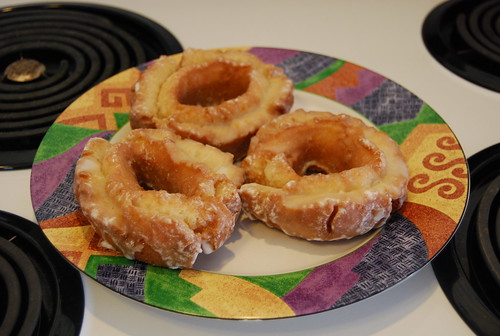
Where the-day-before-Lent is concerned, nowhere is this more apparent then in Central Pennsylvania, where I grew up. Central PA was largely settled by Germans and, accordingly, maintains a number of German traditions. In addition to producing multiple types of potato salad and the best pretzels in the world (seriously, I've been to Germany and ours are better), these include the hallowed tradition of Fasnacht Day. What, you ask, quite rightly, is a fasnacht? For the uninitiated, which once upon a time included my grandmother, who hailed from the exotic land of non-German Pennsylvania, the fasnacht is a donut that looks something like this. Two fascinating things about Fasnacht Day: 1) In Pennsylvania Dutchland, donuts are donuts 364 days a year, adopting the name fasnacht, the name of southern Germany's carnival, only on Shrove Tuesday. 2) Most Pennsylvanians of German descent are Protestant, while giving up things for Lent is more popular among practicing Catholics, a paradox which calls into question the necessity of emptying one's kitchen of lard on a random day in February. But hey, let's not nitpick.

My only experience of a genuine Central European carnival happened in Prague in 2006. My friend Werner dragged me to Kino Aero in Žižkov. The Plastic People of the Universe were onstage. Fake meat was hanging from the ceiling - the name of the festival, Masopust, means, literally, something like "stop meat." Beer was flowing and the atmosphere was closer to what I imagine that of a New Orleans Mardi Gras to be, though I have never attended.

In London, Shrove Tuesday disappears into the ignominy of "Pancake Day". When I first heard of it, advertised a diner as "Pancake Week", I didn't connect it to Lent at all, suspecting it was akin to Arbor Day, International Book Day or similar...As with most British interpretations of feast days that have their roots in the Christian calendar, it feels oddly commercial and alienated from these sources. My local Waitrose went so far as to erect a special display of all the ingredients one would need to make pancakes. So much for emptying ones cupboards of comfort foods verboten during Lent - instead we were being encouraged to go out and buy them!

It's all quite Platonic, I suppose - there's the form of the thing, epitomized by Carnival in Venice or Mardi Gras in New Orleans, and then all our little local attempts to participate, via a circle of fried bread, plastic sausage or humble flapjack. One wonders, increasingly, why we bother at all, particularly in nations firmly on the path to mass atheism. What earthly pleasures will we deny ourselves for the next 40 days to justify a day of gorging on circular pastries of one kind or another? It's kind of sad, actually...though a glance at the clock tells me its now over. And I haven't eaten a single fasnacht. What would my Grandfather, descendant of fasnacht-devotees, say.


Monday, 6 February 2012

Disillusionment in three

Apologies for the somewhat pessimistic tone of this post, but I do have the flu, after all. Not just any flu, either - by far the worst flu that I have ever had in the UK. It is not as bad as my worst flu ever, which I caught in Prague, while living in Mala Strana. That was the kind of flu that makes things spin, which is quite interesting when you live in a neighborhood full of baroque architecture...but I digress.

As I have not left home for several days - indeed, I have only recently regained the ability to use my laptop - I shall beg the readers' indulgence for a post of this nature.

Disillusionment No. 1. Gig-going in Camden.
One of my resolutions upon moving back to London was to try to hear more live music, as a result of which I found myself on Thursday evening squeezed into the upper room of the Lock Tavern for the Young and Lost acoustic night. Perhaps the unbelievably pretentious faux-angsty title should have put me off, or perhaps I should have heeded A. A. Gill's warning that hanging out in Camden past a certain age is "cause for self-pity", but Stranded Horse, who I deeply love, was playing. So I had to go. And force others to accompany me. I in no sense fancy myself a music critic, but whoever curated the evening needs to have a word with themselves on multiple levels: of four acts, the first two were clearly superior, the sound engineering left much to be desired, and one band in particular beggared belief. Image a parody of a parody of 1950s Big Band with a vocalist alternative channeling Anthony Kiedis and Modest Mouse. Add dramatic hand gestures and subtract any sense of irony or humor and you begin to get a sense of the pain. Then there was the behavior of the crowd. Why go to hear live music if you're going to talk, loudly, throughout? Still, Stranded Horse was lovely (that's him, below) and the rudeness of the assembled audience proved an excellent aid to overcoming my habitual unwillingness to speak to artists - saying thank you felt quite necessary after all the loudness.


Disillusionment No. 2. Snow siege in Crouch End.

So it snowed on Saturday night, which was deeply exciting. As someone from a country with four actual seasons (though these are often reduced to summer and winter) the monotony of the UK climate tends to get me down. Snow makes me happy. Watching it fall makes this song start playing in my head. As a child, freshly fallen snow always placed me in a dilemma - I really wanted to play in it, but hated to disturb the beautiful pristine frostiness. No such quandary seems to have troubled the brave young men of Crouch End, who, upon being ejected from Kiss the Sky around 1am, proceeded to pelt my row of houses and any passing cars or pedestrians for thirty minutes. Far from being the magical substance of my youth, snow in London, as seen above, seems to be prized primarily for its efficiency in providing the local citizenry with frozen weaponry. Bless, perhaps it's all just too much for them.

Disillusionment No. 3. The elusive B359.
P and I having been stricken simultaneously by this plague (and having watched all available episodes of season 8 of House), we decided to take advantage of our housebound state to research some unsolved mysteries. Having previously determined precisely who (or what?) Peppa Pig is and source of taramasalata's high fat content, we set about locating the precise location of the B359. For the uninitiated, this the road that Hugh Grant's character misses the turning for in the first nuptials of Four Weddings and a Funeral, leading to much swearing and general hysteria. Turns out it doesn't exist. It is actually the A359. We know this because of an absurdly pedantic website about Dorset in film. Perhaps David Cameron should worry less about British cinema's financial viability than its factual accuracy, eh?

As it seems that everyone and their great aunt Beulah is sick right now, to what absurdities has the flu (or the wintry weather) driven you and yours?

Friday, 3 February 2012


Has anyone else noticed this sign on a recent tube journey?


It's surprisingly hard to take a clear photo while on a moving escalator, so I shall translate: "Are your skills in demand overseas? Visit the Emigrate show." I confess to a level of perplexity and confusion - it's quite an oddly complex piece of work, isn't it? On one hand, it feels like a recession-busting scheme, as in 'Can't find a job here? Then why not shove off and seek employment elsewhere (whilst conveniently bringing down our unemployment numbers in the process, innit)?' Then, as if that's not unsettling enough, there's the sense in which it seems to be suggesting that here is indeed a possibility (wait for it...) that life just might be as good -or better?! - outside the UK.

This second proposition is truly revolutionary stuff. I number many a critical Brit amongst my close friends and associates, but, as is the case in the States, the official rhetoric tends not to be so self-reflexive. In the 5 years I've lived in the UK, I've been queried extensively on, among other things, my qualifications, work experience, seemingly bizarre interest in the Czech Republic, disdain for fake tan, the capitalization and pronunciation of my own surname and whether I really need to see a specialist for something my GP can surely handle by flipping through an abridged medical encyclopedia. Such experienes are part of life outside one's native land and, if nothing else, provide amusing fodder for blog posts. I mention them because the implicit sense behind such challenges is the notion that the British way is the most natural and/or highly-evolved manner in which to handle whatever's at stake.

The emigration sign, then, upsets the applecart of casual, public nationalism in a quite radically shocking way when you get down to it, or so it seems to me. Indeed, it feels downright portentous. This is especially the case when coupled with a recent article in the Sunday Times Style mag in which Chav was rebranded as Chinese Accessories Victim - in honor of the Beijing fashionistas converging on New Bond Street and creating a market for shop assistants who speak their native tongue. In this brave new world, one can't help but wonder what's booking up faster: the emigration fair or City Lit's courses in introductory Mandarin.