Tuesday, 28 September 2010

The Perils of Over-Thinking; or, How not to take a language class.

As of today, I have had lessons with both of my new Czech teachers and I am thrilled. Yes, that’s right, I have two: one for grammar and general language development, the other for more grammar and professional vocabulary development (so I don’t sound like an idiot while endeavouring to use a library or to explain that I am writing my thesis on Czech theatre). While no one will ever replace my first Czech teacher in my heart – despite emerging from my year living in Prague with a nice collection of nouns, I could barely string a sentence together when I joined her class and she helped me enormously – my new teachers are pedagogically sound, professional and generally impressive, which is lovely after the surprisingly old-school approach of Letní škola.

It transpires, however, that while their teaching is excellent, I am not such a good student. Oh, I learn what they’re teaching me. That’s not the problem at all. My problem consists of my compulsive need to be authentic. Perhaps I’ve absorbed too much of what Václav Havel has to say about the importance of living in truth, but I find it virtually impossible to answer questions designed for controlled grammar practice without pausing to reflect. I interpret the most banal requests as existential conundrums of epic proportions. This morning, my teacher asked me to answer this question: “Of what is there less in Prague than in London?” Rather than rattling off something easy like “Indian restaurants” (in the genitive plural) in response to the above-question, I thought for a good 30 seconds longer than should have been necessary, creating an awkward silence as I nominated and rejected one answer after another. The first answer that popped into my head (my friends!) was honest, but seemed too personal for the first lesson, while the second (drinkable wine) seemed insulting and risked making me look like a wino. Finally I hit upon what seemed like the perfect reply (antisocial behaviour), but then I couldn’t remember the word for behaviour, despite giving a presentation on this very topic last month. In the end, I went for the practical, if random (fresh coriander).

The rest of the lesson, continuing on the theme of comparisons, was an interrogatory minefield – “What do the majority of Czechs do?”, “What is true of a handful of Czechs?”, “Which of these mobile phones is the oldest, largest, lightest?”, “Who is a better student, you or the other students in your programme?” That last one nearly sent me into cardiac arrest, especially after the trauma of evaluating the three phones my teacher and I had between us. (I don’t know which one is the oldest. I can guess, but what if I’m wrong and say something really offensive?!) Rather than subjugating truth to grammar and saying something – anything! – I diplomatically explained (well, as diplomatically as I can explain anything in Czech) that this is an impossible question, as everyone in my programme is working on a different topic and we are therefore not in direct competition. I managed to work some of the target language into my explanation so as to not entirely abstain from the task on ethical grounds, conscientious-objector style.

I think the majority (většina, see, I told you I was learning) of my language class anxiety stems from my experiences as a teacher. I know for a fact that teachers talk about their students. Some of my oddest students have included a Czech guy whose girlfriend’s cat always ate his homework, another who looked like giant baby, was terrified of public transport and professed to be interested in nothing, a Russian twenty-something obsessed with Vladimir Putin to the point that he dressed like him, a Russian girl who despised Yulia Timoshenko and the idea of women taking part in public life and a Turkish guy who managed to insert sexual innuendos and emoticons into the most innocent assignments, including a formal business letter! These are the war stories I tell my fellow teachers, and while they’re often highly amusing, I so do not want to be one of these people. To compound matters, I’m also conducting these classes entirely in Czech; whereas my first teacher knew my (comparatively) sane, (relatively) charming and articulate English-speaking self, these new ones are left alone with my Czech persona, and lord knows what she’s capable of saying!

Fellow language-learners, does this ever afflict you, or am I alone in this absurd linguistic psychodrama? Perhaps this problem will abate with time or increased fluency? It suddenly occurs to me that perhaps the wacky students I've mentioned above had actually adopted those alternate personas in order to cope. Language class as acting excercise? Hmm...I'll have to think about that for awhile.

Wednesday, 22 September 2010

Expat or Foreigner? Cizinecká Policie v. Česká Spořitelna

On Monday, Mr P and I had two extremely diverse experiences of expat life in Prague. Where did we go to achieve this? Well, first we went here:

And then, a bit later, we went here:

The first photo is our new Czech bank, Česka Spořitelna on Rytířská ulice in Prague 1. The second, is the Foreigner's Police in Pankrac. The two could not be more different and experiencing both on the same day was something of a head trip.

First there's the terminology. Česka Spořitelna is equally famous for its gorgeous interior and its Expat Centre, which allows you to conduct all your banking in English. When you open an account, you are plied with tea, coffee and sparkling water and offered a variety of discounts on local services (including a slightly pricey gym which we had both, annoyingly, already joined). You're also asked to fill in a card listing your favourite leisure activities, so ČS knows to which of its swanky sponsored events it should invite you, the coveted expat customer. At the CP, by comparison, there are no expats, only foreigners. While I don't love the term expat (too often a glamorous-sounding synonym for socially irresponsible adult adolescent), "foreigner," at least in English, feels quite rude and calls up images of a crowd of Tea Partiers armed with pitchforks, hillbilly accents, tar and feathers. But I digress…

For our stint as foreigners at the cizinecká policie (CP) in Prague 4, Mr. P and I arrived armed with our passports and health insurance cards and accompanied by Nora, our unflappable immigration agent. We needed an immigration agent because the foreign police (despite the fact that the people they deal with are almost exclusively non-Czech-speaking) speak only Czech, and while my vocabulary is reasonably adequate for most daily interactions, Czech legalese is well and truly beyond me. We also needed help because the regulations and paperwork necessary for applying for residency in the ČR are constantly changing, making it difficult for a lay person to keep remotely on top of which forms and documents are currently necessary. We had thought our case would be fairly straightforward, Mr P being a European citizen and all. We'd had a visit from a couple of CP officers (which sadly I missed), who examined our flat (how many people live here?), our photographs and our wardrobes, followed a few weeks later by a letter instructing us to appear to pick up our resident permits. Stress free, right?

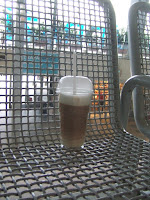
Wrong. First off, there's the atmosphere of the CP itself. We arrived at a modern building in Prague 4, where an open door revealed a shiny, white police station. I was just thinking "ah, not so bad", when Mr P pointed out a sign on the door directing us to the next door, which opened onto a far dingier scene, somewhat reminiscent of a US DMV in all its take-a-number-and-wait-five-hours splendour. (That's the Department of Motor Vehicles, for the uninitiated, aka the place you go to when you need a new driver's license, or want to experience Soviet-style bureacracy coupled with American righteous indignation – a fascinating juxtaposition, really.) The chairs were uncomfortable, wire-mesh creations, but at least there was the ubiquitous instant coffee machine in case we hadn't had enough coffee at the bank, though by the time I spotted it, the atmosphere had me so stressed out that the thought of consuming anything made my stomach churn. The creepiest thing about the CP were the doors. I really wanted to photograph them, but was scared I'd be yelled at for doing so, so description will have to suffice. I needed to use the bathroom and the doors to get there were all numbered, in creepy block numbers more suited to jail cells than public conveniences. Also, they weren't in numeric order. Door 47 (WC pro zeny) opened to reveal doors 13 and 62 (stalls, only one of which actually opened). I felt trapped in a prison film, a suspicion which increased when I washed my hands and was effectively hosed down by an overzealous tap and emerged dripping. Lovely.

Mercifully, we didn't have to wait long, as Nora had arrived early to get us a good number. We did encounter some difficulties surrounding Mr P's accidentally laundered passport and previous Czech residence permit, which had been retained by his last Czech employer and was thus not on his person. The lady dealing with our case was about to fine him 3000kc (£100) for not having it, when a passing colleague told her that to do so would be ridiculous, as the permit had expired anyway (whew!), so in the end, we were let off with only a bit of hassle. Hassling seems to be what the foreigner's police do best. Why make a simple request when it's so much more fun to harangue? For example, US passports list the state, not city of birth. CP lady wanted my city of birth, so first she called Nora to the desk, who then called me to the desk and explained what was required. While I was writing it down for her, CP lady continued to lament that "Pennsylvanie" was not a "konkrétní místo" (a concrete place) and that she needed the city. I wrote "Harrisburg, PA." CP lady entered "Harrisburg" on my residency permit, which, ironically, is not at all a konkrétní místo when separated from the PA bit, as god knows how many Harrisburgs there are in the United States! (A quick google search reveals Harrisburgs in Utah, Arkansas and California, for a start.)

In the end, however, all was well and I was issued with this lovely blue document, which means that I am legal. What excites me the most, though, is that I can now finally get a library card with borrowing privileges at the city library (hurrah!) without a friend needing to vouch for me.

Still, a few days later and I'm feeling distinctly ambivalent about both these experiences. A friend recently pointed out to me that my Facebook location still lists London as my current city. I know it does. I know I should change it. I just can't seem to. Coming here has left me feeling so dislocated – between here, there and somewhere else, with the place I'm coming from not the place I'm from, though it was for the past three years. If that sentence is confusing, it's meant to be. I'm a bit of a psycho-geographic jumble at the moment and don't know where I'm coming from or going to. None of this is aided by recent political events in the US, which have me wondering whether I need to go home and pitch in against the lunatics (I'm convinced, after seeing this photo of Christine O'Donnell that Sarah Palin is actually asexually reproducing) or seek political asylum here in Europe. Sigh. Do you always know where home is?

Thursday, 16 September 2010

Unexpected coupling…

When I lived in Philadelphia, I was once in a train crash. I was seated on board a stationary local train at 30th Street station when the express train drove into us. It wasn't moving fast and no one was hurt, but we all felt the impact. Moments later, we were informed that what had occurred was not a train crash, but rather an "accidental coupling"; the impact had caused the express to attach itself to our train. Cue much amusement for the passengers as we explored the possibilities of SEPTA's suggestive description of our predicament.

I have just experienced another unexpected coupling on rails, this time an unsuccessful one, mercifully. I am on my old friend the EC Polonia, which I caught at the ungodly hour of 6.45 in order to be back for a performance in Prague this evening. As a thank you for my professional diligence, which meant leaving Warsaw – and Mr P – before I am usually awake on a weekday, let alone on a Sunday, I have had the pleasure of sexual overtures from the deeply misguided young man sitting across from me in the carriage. Did he think that because a man put my bags on the train and kissed me goodbye that I would be lonely and in need of some comfort? Did he think I have a lover in every city on the EC Polonia route and would now like one for the between-cities bit as well? Did he think that the Heineken he offered me (mind you, it was about 7.30am at the time) would change my mind? Whatever his intentions, it was deeply unpleasant and has left me terrified to decamp to the loo or dining car, lest he slip date rape drug into my water bottle or rifle through my carryon. Unhappily, he has also fallen asleep, stretched out full length across three seats, which has thus far deterred any neutralizing third parties from joining our carriage and diffusing the situation. I have never been in such a hurry to get to Ostrava!

I had intended to write about the fab nightlife in Warsaw – I've been saying for years that I want to open a club whose playlist will be equally influenced by Jack White and Edith Piaf and finally found such a place this weekend! – but I'm feeling so disheartened – not disgusted so much as a flummoxed and oddly depressed – by my travelling companion that I need to address the topic of such behaviour. How? Why? What on earth did he – and all who behave that way – think was going to happen?

I've become more aware – and wary – of unwelcome advances since being back in Prague. I think there are a few reasons for this, which have more to do with me than the perpetrators. For one thing, in London I rarely went out on my own at night – I was always either with friends or Mr P – and if I did I was home before the tubes stopped running. I lived in a neighbourhood where no one bothers you unless you have lived there for most, if not all, of your life and are therefore implicated in one kind of urban turf war or another. I was largely invisible there, while on the tube I was protected by the unwritten rules of Transport for London, which forbid eye contact with strangers, let alone conversation, therefore necessitating the devotion of numerous column inches in Metro and The Evening Standard to "I looked at you for ten seconds between Bond Street and Green Park"-type messages. I did get the odd whistle or "give us a smile, love" from builders engaged on various projects in my neighbourhood, but these days I can think back on their casual objectification of my person with mild nostalgia, since they never invaded my personal space or tried shamelessly to look up my skirt when I stopped to tie my shoe, two of my least savoury experiences in the last month.

I'm not going to go on some sort of horrible anti-men rant here, or debate which countries' lotharios are the most brazen. I like the Czech Republic's healthy, non-judgemental attitude to sexuality and the body. It makes for good cultural products and allows women of all ages to tan topless in a family environment, or enjoy a sauna sans bathing suit, activities which would be interpreted much more sexually in the US and UK. I also like clothes, I like to look interesting and, while attracting men is not my motivation, I accept that unsolicited – and unwelcome – attention is bound to come to all women at one time or another. I won't deny, either, that the occasional street compliment can occasionally boost the ego. I remember the first one I received – I was college shopping in New York City and was catcalled by a group of French waiters on a smoke break. I was eighteen and delighted, my father, who was accompanying me, less so. One of my favourite sartorial accolades came from another French waiter, this time in Paris, who declared my ensemble "formidable!" and rushed to my aid with an ice cube and boiling water when I dripped some vinaigrette on a cream silk blouse. He was sweet and it made me feel fabulous. I will remember it fondly when I'm a nice old woman.

What bothers me most are the moments when my gender – and age, as I suspect this will become a less frequent occurrence with time - seem to render me incapable of securing moments of quiet and reflection when I desire them. Like on a train. Or perhaps a bridge. I live quite close to the river in Prague and my walk home often takes me across a bridge. During the day it's full of car and tram traffic, but at night it is peaceful and lovely and sometimes I would like to stop and gaze out at the water for awhile. I don't do this, however, since the last time I tried, two different men interpreted my behaviour as an invitation to pick me up. I don't know the solution to this, apart from wearing a hat like this. But I wish it didn't occur.

Happily for my personal well-being and sanity, I have no more solo train journeys planned for the foreseeable future and will be spending the next three weeks in Prague. I'm looking forward to a bit of time in one place and the chance to write about adventures not taking place on rails.

PS – I wrote this on Sunday, but didn't get round to posting it until today, when I heard a relevant report on Radio 4's Woman's Hour about the London Anti-Street Harassment Campaign. The movement's founder says it's meant to empower women and eradicate street harassment. A male commentator thought that the campaign implies that women are weak and unable to handle unwelcome attention and said attempts to curb men's comments amounts to the policing of thought. What do you think? Is a "hey, baby" or "look at the legs on that!" in the same league as ethnic and religious slurs, or do we just need to toughen up and get over it?


Tuesday, 7 September 2010

From a library in the frozen north…

I'm back in Warsaw, after a quick working week in Prague. This was the trip I was always planning to take, though the excessive back-and-forth-ness has left me feeling two things: first, that I live rather more here than there at the moment, which doesn't distress me, as I continue to like this city; and, second, that three eight-hour train journeys in the space of seven days are too much, even for someone who loves movement as much as I do.

Since I'm not confined to the weekend, I've had a chance to experience the day-to-day-ness of working in Warsaw, which for me means finding a good library. I wish I was the sort of person who could read and write texts more complicated than email effectively against the backdrop of café-noise, or that I could discipline myself to work at home, but after much trial and error I've accepted that libraries just work better for me. As a result, I have quite a collection of international library cards, the newest of which I acquired yesterday:

My endeavors to photograph it haven't gone too well – it's sort of come out all blurry – but I love this photograph. The lighting is almost painterly. It was taken by a Polish undergrad-type manning the registration desk at the University of Warsaw Library, which is equipped for this purpose with a light not dissimilar to those I encountered at the London College of Fashion. The library is located off Nowý Swiat – I know which street to turn down thanks to an enormous statues of Copernicus conveniently located at the intersection. The full name of the library is Biblioteka Uniwersytecka w Warszawie, which offers a fascinating glimpse of the differences between Czech and Polish, a topic currently occupying much of my attention. In Czech, the word knihovna is used for library, which can create some confusion since the word for bookshelf is also knihovna. You can alleviate this problem by using the diminutive form to distinguish between them. The Poles have avoided this altogether by using the Latinate biblioteka. This is fascinating to me, having studied the modernization of Czech in the eighteenth and nineteenth centuries, when there was much squabbling among grammarians about the appropriate sources of new words. The attitude that was eventually adopted was quite conservative – loanwords should come, if at all possible, from other Slavic languages or be created from Czech themselves. Thus, Czechs can borrow a kniha (book) from a knihovna, while speakers of Polish, which seems not to have had such a conservative loanward policy, use a biblioteka, despite the fact that the Polish word for book is książka. Linguistic analysis aside, I like this library, which looks like this:

On the ground floor there's a sort of atrium thing that contains Coffee Heaven – Poland's answer to Starbucks – as well as used book kiosks and a poster shop I want to visit today. Within the library itself, I have found a wonderful book by Eva Hoffman called Exit into History, which documents her travels through post-Communist countries in the early 1990s. It's very personal with lots of material from interviews, as well as her own reactions to her experience, which makes it incredibly insightful and unpretentious and – from my point of view – very helpful. She also talks about the frustration of being unable to use Polish in Czechoslovakia very effectively, a situation I am now experiencing in reverse. I feel an overwhelming desire to wear a badge, like those sported by Costa Coffee baristas in London – festooned with little flags conveying the information that I am able to function reasonably adequately in more than one language. It is a bizarre situation to be able to read, and even understand, (though as always, my language skills are better in written form) while being unable to produce anything. I feel profoundly guilty that I can't answer an old lady's question about which bus stop is next, even though I know that's what she's asking. I also know that this response, as I told Mr P (in an extremely rare low moment of his own last week), is irrational, as there is no way to master a complex language within one week of arriving somewhere, even if one has a good working grasp of a related language. At least the Poles are nice about it, generally. Yesterday a research student asked me to take part in her study and when I told her I couldn't speak Polish she still gave one of the cookies she'd brought along as thank yous to participants. Bless.

In other news, it's freezing here! The freezing starting on Monday, but before that it was quite beautiful, as in this picture that I have chosen to leave you with, taken at a concert of Chopin music in Lazienki Park.

(And yes, that's a stature of Chopin looking on…apologies to random girl on the right. I really need some photo editing software of greater sophistication than Paint.)

Monday, 30 August 2010

Prague to Warsaw Odyssey, Part 2


I made it! Yes, I'm here. Once I left the Pendolino train in Ostrava, it became a bit of an adventure. My next train, the EC Polonia from Vienna, was delayed by twenty minutes, so I had time to sample a local speciality: the Ostrava latte.

Add Image

When I ordered it, I thought it must have been a mistake, until I saw about half a dozen people ranging from a young crusty couple to a professional twenty-something drinking the same thing. Apart from hot beverages served in cups obviously designed for cold drinks, Ostrava delighted me by playing the sorts of train station songs (composed of the bell-like sounds that precede announcements of arrivals or departures, and always make me feel like boarding a train for Moscow or Bucharest) that used be common at Hlavní nadráží pre-refurb. I also realized, while there, that I can now understand train announcements in Czech, which delighted me, as I still think I can't speak or understand it properly, even after 100 hours of instruction in the past 4 weeks. Unfortunately, the EC Polonia didn't function as well as my language skills – we had made it one stop out of Ostrava when the train ground to a halt. Forty minutes later, after much frantic running back and forth by engineers in orange overalls and an announcement in Polish that I couldn't understand , we were finally on our way again. I was greatly relieved, since given the start to my journey, an announcement advising us all to detrain and seek accommodation in Ostrava and environs until the next day would not have seemed at all out of keeping with the mood of the journey. Luckily there were no more breakdowns, though the journey did become marginally more interesting at Katowice, when the Viennese hipsters in my carriage were replaced by a mother with two daughters in their early twenties, one of whom looked like she'd just been in a fight. If only I could understand Polish better…

As for Warsaw itself, I had a great weekend. I don't understand why the city gets such a bad rap. Perhaps I'm more predisposed to like it – there aren't many American cities with the concentrated beauty and consistent charm of many of the European cities I've visited, and I suppose if you're used to Bath, or Prague or Vienna, then Warsaw is something of a monstrosity. But for an ex-Philadelphian who's risked life and limb navigating the museum district on foot or going to a concert at the Electric Factory, crossing four lanes of speeding inner-city traffic to get to dinner doesn't create a lot of cognitive dissonance. To be totally honest, I find the motorists of Warsaw a lot easier to deal with – and less intimidating – than the cycling hordes of Amsterdam. I also love the air. The city's built on sand – when you cross the Vistula, on the east bank you can actually see a sandy beach – and the air feels saltier and cleaner than in Prague. It was windy this weekend and freezing for August which only enhanced the crispness. Plus it has some green parts, like this park by Mr. P's flat:

The people watching is fab – lots of cool style going on in Warsaw, which seems not to be plagued by the grown-up skater/punk style that haunts Prague – and great bars. We went out with some of Mr. P's new colleagues on Saturday, which ended up being a tour of places I want to go back to – an arty club in the vaulted-ceilinged basement under the Zacheta gallery, and a lounge with fantastic chandeliers and a retro-glam vibe hiding in a courtyard nearby. Early in the day, we went to Praga and found this delightful, artist-haunted and book-filled café in a converted vodka factory (which reminded me of the set of Karamozovi)...

...then stopped at another on our way back, where we found both Becherovka and a wonderfully atmospheric dark interior. Then there's the sense of history, which is everywhere you turn. The city feels like a geode – grim on the outside, but sparkling inside. Dark and haunted and hip simultaneously. I love it. So far.

As for now, zpatky do Prahy na práci – I am so behind on work. Which I'm going to start doing. On the train. Right now. After I figure out if the men in my carriage are Czech or Polish. I think they're speaking Czech, but they're reading Polish newspapers. But I can read Polish a bit, so they probably read it very well. But I can't understand them very well. Maybe they're Moravian? Oh the endless joys of Slavic languages.

Saturday, 28 August 2010

Prague to Warsaw odyssey, Part 1

I wasn't even supposed to go to Warsaw this weekend. Mr P. was supposed to come to Prague, but it seems that, despite my protestations that Warsaw isn't really that bad, any Czech resident there who's able to hightails it back to Prague at the weekend. Traveler be warned: book your Friday night plane tickets well in advance. Since everyone is coming here, I've been left with no choice but to go there. And what a journey it's been thus far.

This the Metro C station at Hlavní nádraží.


Four hours ago, when I really needed to use it, it was closed. I found out while on a stationary train at I.P. Pavlova, when the driver announced that we would not be leaving the station after all. It was 9.45. The train to Warsaw was leaving at 10.11. I didn't understand how this could be happening. While living in London, I proclaimed the genius of the Prague metro. It's not like the tube – no weekend closures, no signal failures, no waiting for an available platform at Earls Court. It always works. It's never, in my experience, not worked. Until today, when I had an international train to catch. My caffeine-deprived brain couldn't process the information. Following the crowd out of the station, I decided the sensible thing would be to hail a cab. Except that there aren't any cabs at I.P. Pavlova at 9.50am on a Friday morning. I tried phoning a cab company and was given a 10 minute wait time. No good. At 10.11, I was slightly hysterical and on a tram to Náměstí Miru, wondering how I ever thought another foray into multi-city living was in any sense a good idea.

Not to be daunted by the broken metro and missed train, I proceeded by other means of transportation to the station. I thought I would be consigned to the slowest train of the day, a 10-hour long nightmare that arrives in Warsaw at 10.45, but was rescued by a Pendolino service to Ostrava that would get me there an hour and half earlier, in time for a fashionably late dinner. Score. At this point I realized that it was after 11am and I had yet to eat or drink anything. An early lunch seemed a good idea. But first I had to find the loo. Here it is:


You can't quite make out the blurry blue sign, but it says "WC". Yes, that's right. The loos, in a busy international train station, where people, like the man in this photo, are carrying baggage, are at the top of a long flight of stairs. They also cost the princely sum of 10kc to use, which is a trifle steep, though I would happily fork over twice that amount if all profits went to the construction of an escalator. Considering that Hl. Nádr. has just been through an extensive remodeling, I'm not sure how this happened. How is this at all logical? Whoever designed it seems to have realized that the act of dragging heavy suitcases up there was likely to make one hot and sweaty, as they kindly installed showers (40kc, prosim). Unfortunately they failed to take into account the fact that you'd then have to schlep your stuff back downstairs after showering. Perhaps a shower at each end is the answer? You may right ask if there are luggage lockers at the station – surely the weary traveler can deposit his/her baggage and proceed unencumbered up the stairs? Yes, there is a lovely locker bank. But only, apparently, if you have the right change. I thought I did, until I tried to pay and realized the lockers don't accept coins smaller than 5kc, at which point I gave up and hauled my stuff up the stairs.

After this adventure, I collapsed in the Potrafena Husa restaurant in the station. I had briefly considered running out for something lighter and of Asian extraction, but given how the day was going, I thought it best not to leave the station. I grabbed a table next to a group of semi-annoying backpackers and ordered a šopský salát (tomato, cucumbers, peppers, Balkan cheese, onions) and, from the beer menu, toasty s kozím syrem (toasted bread with goat cheese and caramelized onions). When my food arrived, I appeared to have ordered two large salads. I was too tired to attempt an ironic comment to the waiter or to check the menu again to see if I'd missed the fact that the goat cheese toast came with salad. I just ate them.

In happier news, Potrafena Husa had wi-fi. I started writing this post and was checking the email when the salads arrived. After I'd eaten them and tried to get back online, the network had disappeared.

Now, however, I am caffeinated and on my way, speeding east across the Czech countryside between Pardubice and Olomouc armed with Bourdieu, sparkling water and sláné tyčinky. The Pendolino is lovely and best of all, the loos are at ground level.

Do you have any train travel horror stories to share? Or suggestions for re-redesigning Hlavní nadráží?

Monday, 9 August 2010

From London to Afghanistan via Černošice

It's Monday in Prague and rainy and gray again. On the plus side, my teacher assures us that this is the best weather for studying (unless, like me, you're partial to studying under trees in parks) and Petr and Kristyna have resurfaced in Lesson 2 of Communicative Czech - for those dying of curiousity, Kristyna has splashed out on two tickets to the opera in Italy and has asked Petr - via written note, no less - if he will accompany her.

Romance aside, it's a bit surreal at the moment. While shopping in Tesco last night, Paul and I picked up The Observer. Looking at the front page while queueing to pay, we realized that the leading article about a British doctor killed in Afghanistan was about our upstairs neighbor, Karen Woo. I don't know what to say about it really, apart from that she was lovely. She discusses her relief work in Afghanistan on her blog. Paul knew her better than I did, but I remember her coming to our epic 2009 Fourth of July party and bonding with the pigs. We used to get her post by mistake sometimes...I think we still have some of it.

It's hard to know how to feel in the wake of something as senseless and disheartening as the killing of a group of people authentically responding to the genuine needs of others. Reading the comments some have made on Karen's blog and other sites, there are the usual comments that surface in such situations including an attempt to couch the whole story in religious terms. As for me, I would like to feel empowered by Karen's life and example, but instead I feel predominantly anger and frustration. I am angry, perhaps unfairly, at the free Prague city papers for not mentioning this story - or really any foreign news - at all and instead devoting a full page (for the sixth day in a row) to cities in the Czech Republic with foreign names. I am angry with myself for feeling this way, when it is my choice to live here and my problem that I prefer to turn the pages of my newspaper rather than scroll through them online. I'm frustrated by how much I still don't know, by my inability to speak enough to participate readily in the kinds of conversations that came so easily in London. I am sad to have left a neighborhood where, despite the vastness of the city that contained it, I knew my neighbors and spoke to them. Despite the good times I've had in this city - and know I can have again - I can't shake the feeling that I'm going home at the end of August. I suppose that's the big realisation of the last three weeks...sometime in the past three years, London became home. And for the first time in my life, though it surprises me both in terms of where it's occurring and for what place, I am homesick.

Before picking up The Observer, I had intended to write about my Sunday adventures in the countryside outside of Prague. One of the definite advantages to life in Prague is its proximity to said countryside and though I am admittedly suspicious of any pursuits requiring sensible shoes, I agreed to accompany Paul on a sunny walk from Černošice to Třebotov. En route, we saw...
...fairy tale-esque pine forests...

...an abandoned Jewish cemetery on the edge of the forest...

...and a very small, but aesthetically pleasing church.


That's all I can bear to upload at the moment...for a snap of the smallest frog in the world, you'll have to see my facebook page. I suspect (and Paul concurs) that Karen would have liked the frog.